
TL;DR
You can connect Justworks to the Atlassian Service Collection with OnLink. OnLink imports Justworks member data into a Jira Service Management (JSM) Assets schema, listens to Justworks webhooks to create tickets and asset objects on employee events, and drives onboarding and offboarding request flows with subtasks.
If you are reading thus far, Thank you. We hope to make your time worthwhile. Read On.
This guide covers the three integration patterns that close that gap, and how to configure each one.
Employee data in Assets. Keep a live, queryable employee object in JSM Assets, sourced from Justworks. Use it to link laptops, licenses, and access.
New hire events captured using Webhook. When a member is created in Justworks, a provisioning ticket lands in your IT queue with the name, start date, department, and manager already filled in.
Onboarding and offboarding as structured tasks. One request per employee, with subtasks for each team — IT, facilities, security, payroll.
In a few steps, you’ll be able to import worker data from Justworks to Assets.
member.basic:read (or the scope matching the endpoint you’re importing).GET, URL https://public-api.justworks.com/v1/members, and response data path items.| Justworks field | Assets attribute | Notes |
|---|---|---|
id | Employee ID | Key — used for object matching |
name.full_preferred_name | Name | |
active | Status | Active / inactive |
job_title | Job Title | |
employment_location_type | Location | Work location type |
manager.full_preferred_name | Manager | |
department.name | Department |
next_cursor and keeps requesting pages until no cursor is returned — nothing to configure manually.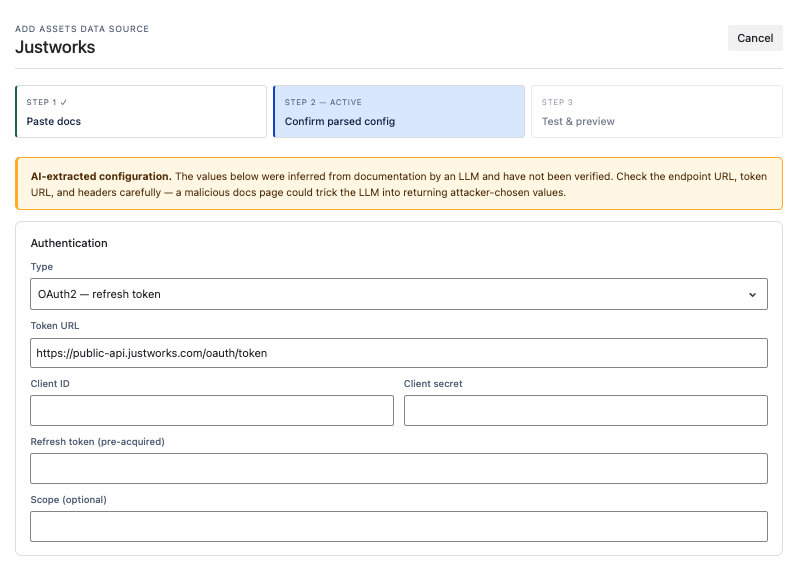
📄 Full configuration reference: Justworks to JSM Assets
Steps
   config:auth_scheme=header_token
   config:auth_token=<12-character-random-token>
Treat the token as a secret and rotate it if it’s ever exposed.
key: for the matching key and map: for values: key:data.member.member_id=customfield_10062
map:data.member.name.full_preferred_name=customfield_10063The payload includes member ID, full name, email, phone, department, job title, employment start date, and timestamps.
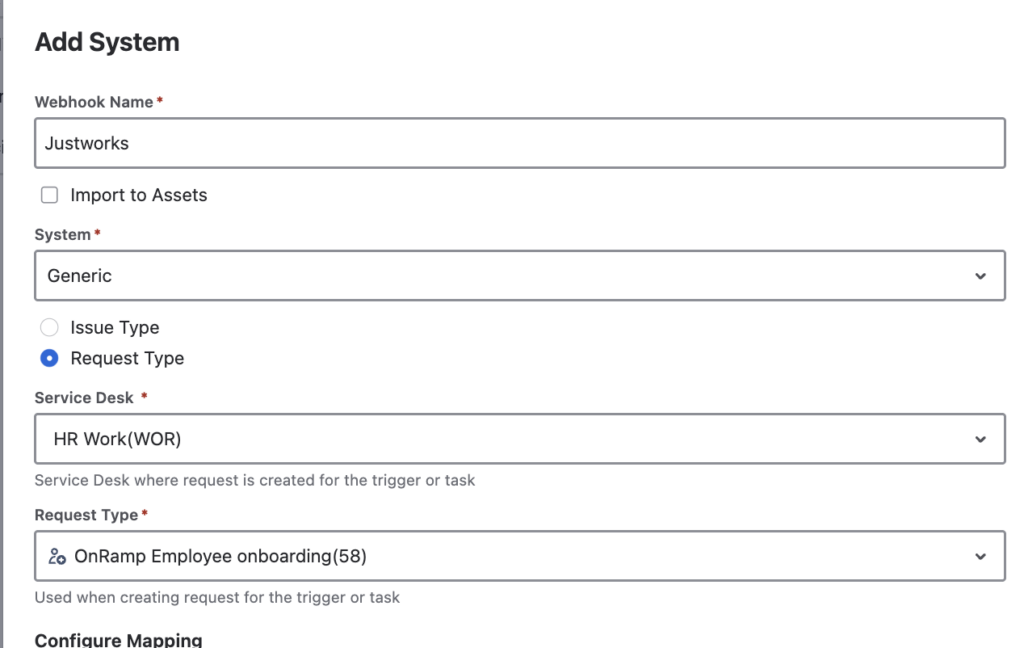
📄 Full configuration reference: Justworks Webhook
This use cases requires OnRamp.
Steps
https://public-api.justworks.com/v1/docs#tag/Members/operation/listMembers ?updated_at_gte={last_successful_rundate}&updated_at_lt={current_date}Available date/time variables: {last_successful_runtime}, {last_successful_rundate}, {current_date}, {current_datetime}.
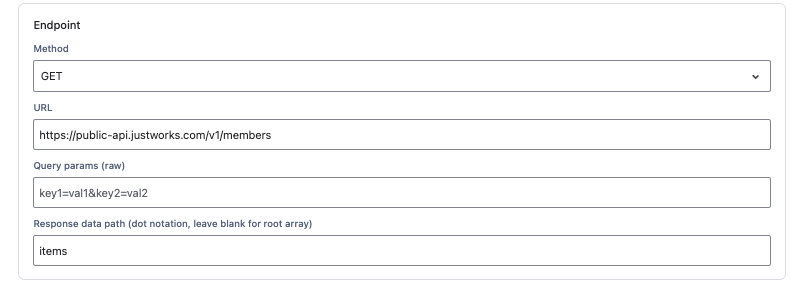
📄 Full configuration reference: Justworks OnRamp Configuration
How does OnLink connect with Justworks and Atlassian Service Collection? OnLink is a Atlassian Marketplace app built using Atlassian Forge. OnLink uses Justworks API to connect.
Can I sync Justworks employee data into Atlassian Assets? Yes. OnLink connects to the Justworks Members API over OAuth and maps fields such as id, name.full_preferred_name, job_title, department.name, and manager.full_preferred_name to attributes on an Assets object type.
Can a new hire in Justworks automatically create a Jira ticket? Yes. Subscribe an OnLink webhook mapping to the Justworks employee created event, and each new member creates a ticket in the mapped Jira project with employee fields populated.
If you run HR on Justworks and support your people in the Atlassian Service Collection, you shouldn’t be copying employee data or have manual imports.
Try OnLink. Connect Justworks to Jira Service Management and Assets, automate onboarding and offboarding.
👉 Start your free trial of OnLink on the Atlassian Marketplace — or book a 30-minute walkthrough and we’ll map your Justworks data to your Assets schema with you.