Top 5 Surveys Every Workday Customer Should Automate

Employee feedback and engagement is a critical piece of organization culture. For CHROs and senior HR leaders managing a Workday environment, surveys are the connective tissue between workforce strategy and day-to-day execution. They surface the signals that drive retention, accelerate onboarding, sharpen hiring decisions, and hold leadership accountable. Yet most Workday customers still rely on fragmented, bolt-on survey tools that live outside their system of record. The result is low response rates, siloed data, and insights that arrive too late to act on. This blog details the five surveys that drive value for Workday customers, the KPIs each should capture, the outcomes they drive, and why running them natively inside Workday with OnSurvey changes the game.

1. Annual Employee Engagement Survey

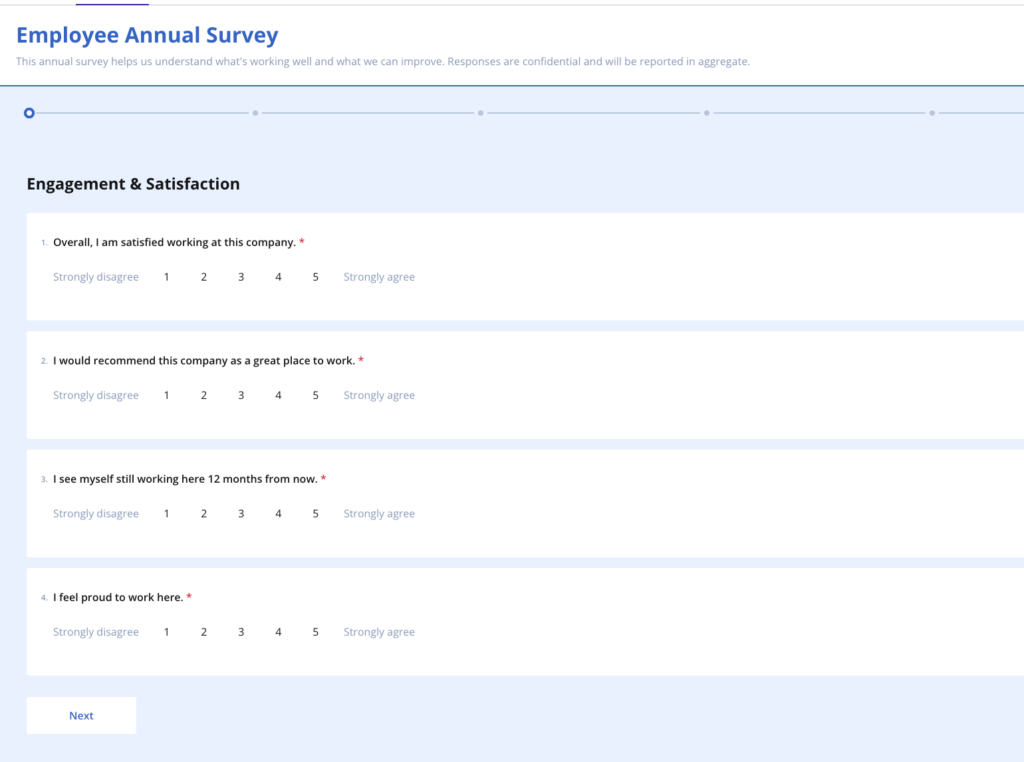
The engagement survey is the cornerstone of any employee listening program. Conducted annually, it provides a comprehensive pulse on workforce sentiment across satisfaction, culture, values alignment, and wellbeing.

Key KPIs

KPIWhat It Measures
Employee Net Promoter Score (eNPS)Willingness to recommend the organization as a workplace
Overall Satisfaction IndexComposite score across engagement dimensions
Intent to Stay (12-month)Predictive retention signal
Culture & Values AlignmentHow well employees connect with organizational mission
Manager Effectiveness ScoreDirect manager impact on engagement


OnSurvey Annual Employee Survey Template


Common Challenges

Most organizations distribute engagement surveys through standalone platforms like Qualtrics or Culture Amp. This creates a data island: results live in a separate system and require manual correlation with Workday workforce data such as tenure, department, and performance ratings. Survey fatigue is another persistent issue, as employees see little follow-through on previous feedback. Response rates stagnate, and leaders receive static PDF reports weeks after the survey closes.

Outcomes It Drives

When executed well, the engagement survey becomes a strategic planning input. It informs retention interventions, identifies at-risk populations before attrition spikes, validates whether cultural initiatives are landing, and gives the C-suite a defensible narrative on workforce health.

2. New Hire Survey

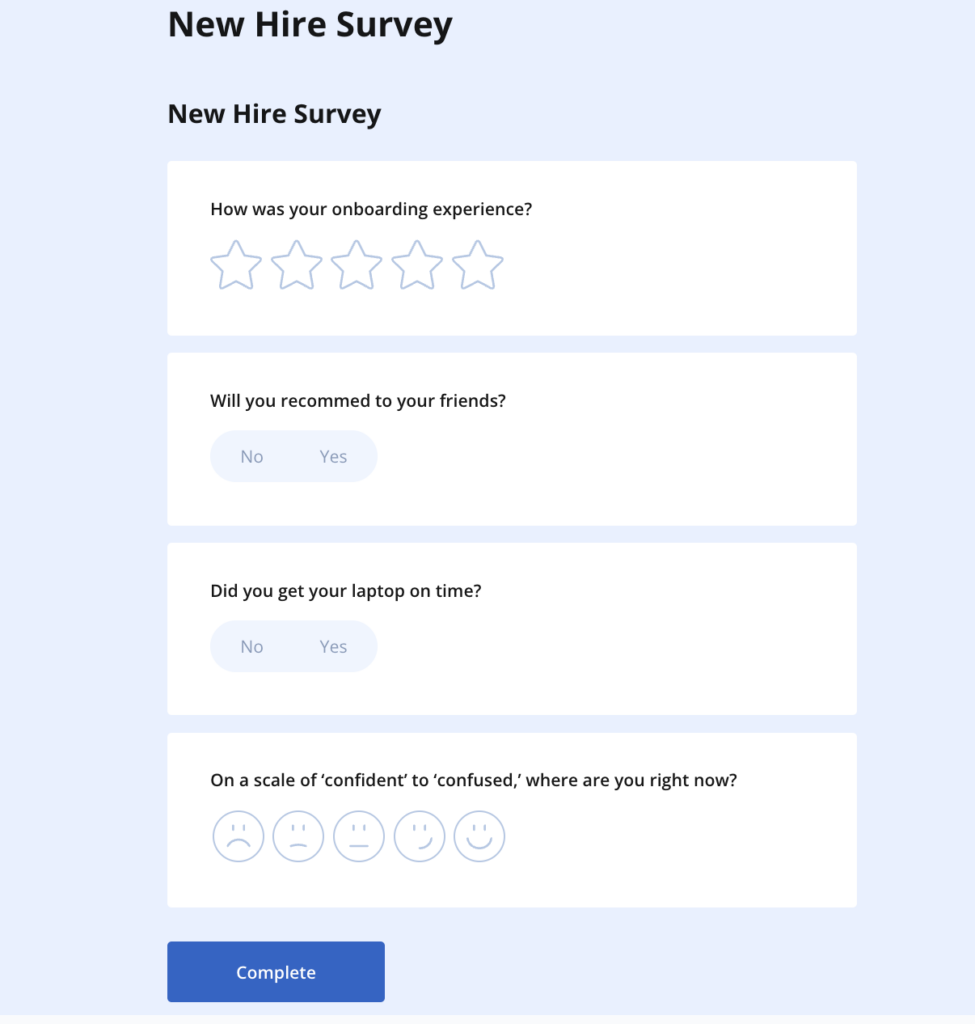
The first 90 days define whether a new hire becomes a long-term contributor or an early departure. New hire surveys, deployed at the 30, 60, and 90-day marks, capture the onboarding experience while it is still fresh.

Key KPIs

KPIWhat It Measures
Onboarding Satisfaction ScoreQuality of the structured onboarding experience
Role Clarity RatingWhether expectations and responsibilities are well-defined
Manager Support ScoreEffectiveness of early manager engagement
Tool & Resource ReadinessDid IT provisioning and system access happen on time
Cultural Belonging IndexEarly sense of inclusion and team integration

OnSurvey New Hire Survey Template

Common Challenges

New hire surveys are often administered through generic form tools or email-based platforms with no connection to the HRIS. HR teams manually determine who to survey based on start dates, creating gaps when hires slip through the cracks. Results are rarely linked back to the employee record, making it impossible to correlate onboarding experience with downstream performance or retention.

Outcomes It Drives

Structured new hire feedback exposes onboarding bottlenecks in real time, whether that is slow IT provisioning, absent manager check-ins, or unclear role expectations. Organizations that act on this data see measurable improvements in 90-day retention, time-to-productivity, and first-year engagement scores.

3. Exit Survey

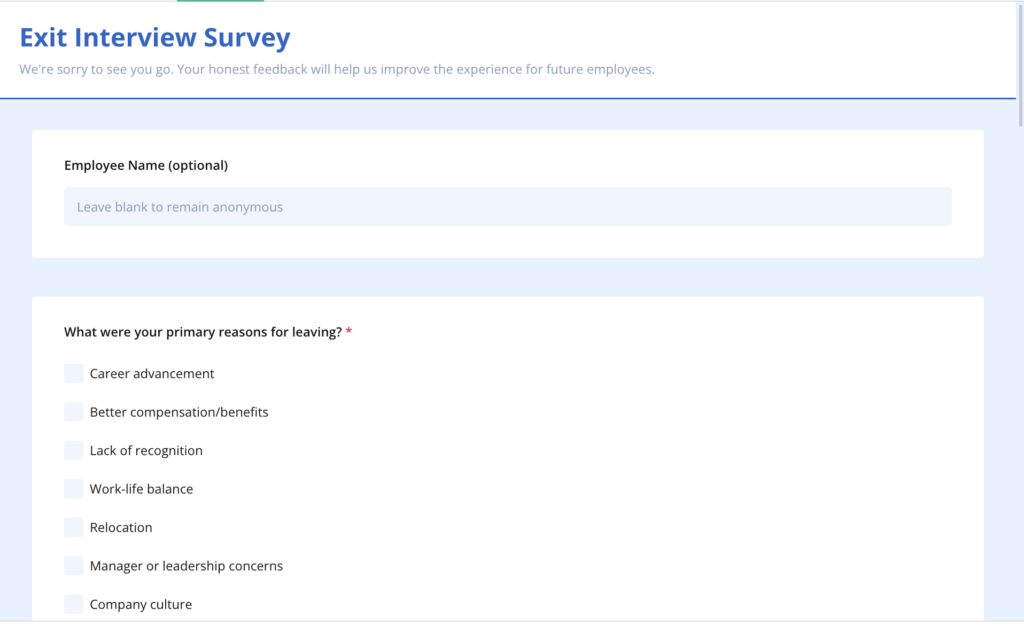
Exit surveys capture the unfiltered truth about why employees leave. When designed for candor and administered consistently, they become the single most valuable source of intelligence on organizational friction.

Key KPIs

KPIWhat It Measures
Primary Reason for DepartureCategorized drivers such as compensation, growth, or management
Manager Relationship ScoreWas the direct manager a factor in the decision to leave
Growth & Development RatingPerceived career advancement opportunities
Likelihood to Return (Boomerang Index)Willingness to rejoin the organization in the future
Recommendation ScoreWould the departing employee refer others

 OnSurvey Exit Survey Template

Common Challenges

Exit surveys are often an afterthought, sent as a generic email link during the final week. Participation is inconsistent, and the data sits in spreadsheets rather than flowing back into workforce analytics. Without integration to the HRIS, HR cannot easily segment exit data by department, tenure band, or performance tier to identify systemic patterns.

Outcomes It Drives

Aggregated exit data reveals whether turnover is concentrated in specific teams, tenure cohorts, or job families. It distinguishes between regrettable and non-regrettable attrition. Over time, it provides the evidence base for targeted retention strategies, compensation adjustments, and management development programs.

4. New Hiring Manager Survey

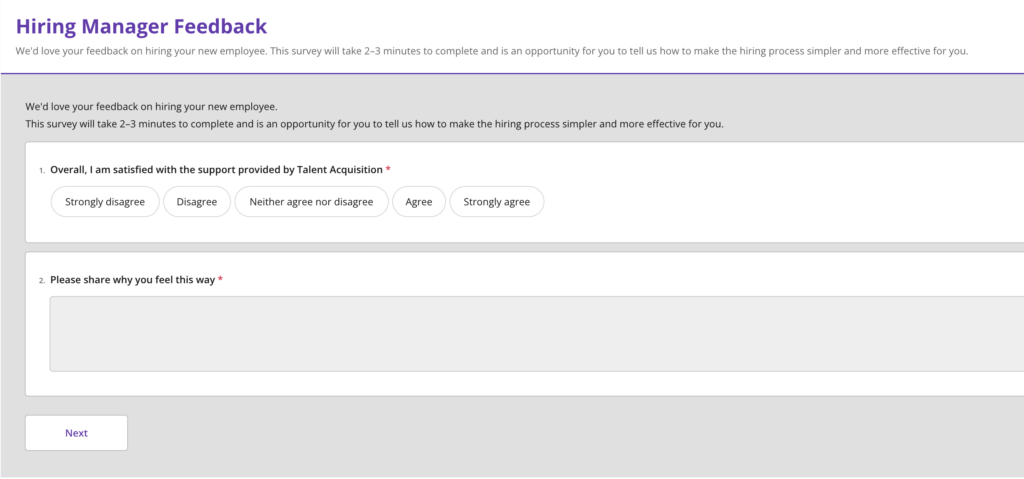
Promoting or onboarding a first-time manager is one of the highest-leverage moments in talent development. A dedicated survey for new hiring managers, typically deployed 60 to 90 days into the role, captures whether they have the support and training needed to lead effectively.

Key KPIs

KPIWhat It Measures
Leadership Readiness ScoreSelf-assessed confidence in core management capabilities
Training & Enablement RatingQuality and relevance of manager onboarding programs
HR & Systems Support ScoreEase of navigating people processes in Workday
Team Transition EffectivenessSmoothness of the transition from peer to manager
Decision-Making ConfidenceComfort with hiring, performance, and compensation decisions

OnSurvey Hiring Manager Survey Template

Common Challenges

Most organizations do not survey new managers at all. When they do, the survey is lumped into a generic engagement survey that fails to capture the unique challenges of a leadership transition. There is no automated trigger tied to a role change in the HRIS, so the survey depends on HR manually tracking promotions and building distribution lists.

Outcomes It Drives

This survey identifies gaps in manager enablement before they manifest as team disengagement or attrition. It informs L&D investment priorities, highlights where HR business partners need to provide additional coaching, and creates an early warning system for leadership transitions that are not going well.

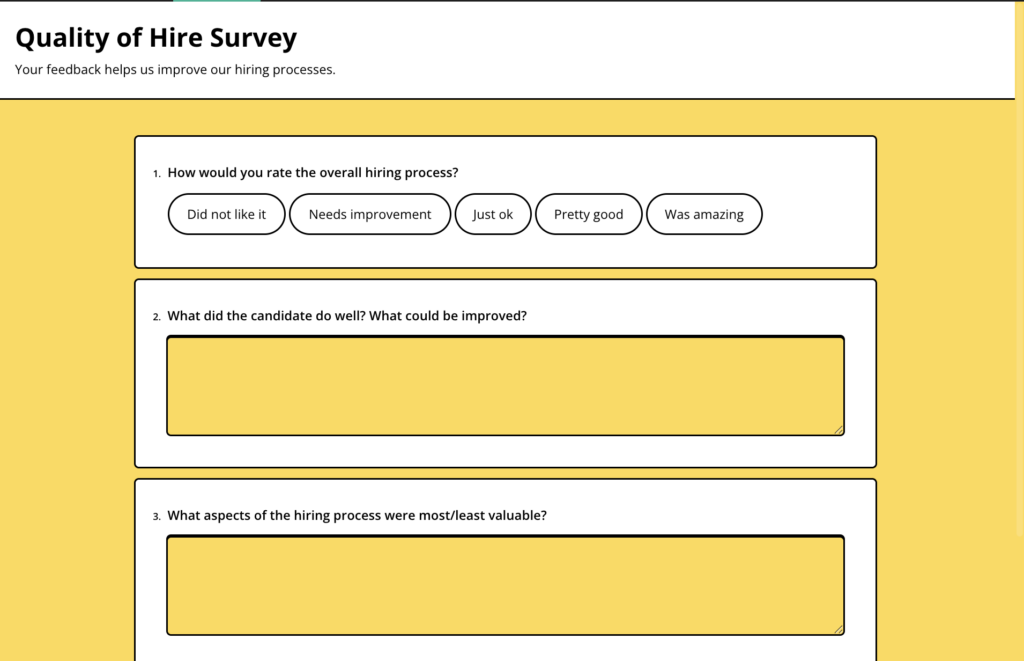
5. Quality of Hire Survey

Quality of hire is the metric that connects talent acquisition to business impact. This survey, sent to hiring managers six months after a new hire starts, evaluates whether the recruiting process delivered the right talent.

Key KPIs

KPIWhat It Measures
Overall Quality of Hire RatingHiring manager assessment of the new employee against expectations
Job Fit ScoreAlignment between the candidate profile and actual role requirements
Time-to-Productivity RatingHow quickly the hire reached full contribution
Recruiting Process SatisfactionHiring manager experience with the end-to-end recruiting workflow
Rehire LikelihoodWould the manager hire this person again knowing what they know now

OnSurvey Quality of Hire Survey Template

Common Challenges

Quality of hire is widely cited as the most important recruiting metric, yet most organizations struggle to measure it consistently. The data requires input from hiring managers months after the hire, and without an automated survey trigger tied to start dates in the HRIS, follow-through is sporadic. Results rarely flow back to recruiting teams in a structured, actionable format.

Outcomes It Drives

Consistent quality of hire data closes the feedback loop between recruiting and the business. It validates whether sourcing channels, screening criteria, and interview processes are producing strong hires. Over time, it enables talent acquisition leaders to benchmark performance, justify budget allocation, and demonstrate measurable ROI to the C-suite.

The Legacy Approach: Integration to Workday

Today, most Workday customers execute these surveys using standalone platforms that operate entirely outside their HR system of record. The typical workflow involves manually exporting employee lists from Workday, uploading them into a third-party survey tool, distributing surveys via external email links, downloading results into spreadsheets, and then attempting to correlate findings with workforce data back in Workday. This approach introduces several systemic problems. Data lives in silos, making it impossible to analyze survey results alongside real-time workforce attributes like tenure, performance, or organizational hierarchy. Survey distribution depends on manual processes that are error-prone and difficult to scale. Employees experience survey fatigue from yet another external tool, depressing response rates. And by the time insights reach decision-makers, the moment for intervention has often passed.

New way is Built-on Workday and that is how OnSurvey Changes the Game

OnSurvey is a native built-on Workday survey solution available on the Workday Marketplace. It eliminates the need for third-party survey platforms by bringing survey creation, distribution, and analysis directly into the Workday environment your employees and HR teams already use every day.

Key OnSurvey Features

  • Surveys are executed from Workday. No external data storage, no separate logins, no data exports. Employee attributes like department, location, tenure, and manager hierarchy are available in real time for segmentation and analysis.
  • Launch any of the five surveys covered in this blog plus many more using Survey builder. Customize questions, rating scales, and sections to match your organization’s priorities.
  • Connect survey distribution to Workday business processes. Automatically send new hire surveys based on start dates, exit surveys triggered by termination workflows, and manager surveys tied to promotion events.
  • Build custom surveys with multiple question types, required fields, and section-based organization. Duplicate and modify questions with ease.
  • Every response is linked to the employee’s Workday profile. Analyze results by any workforce dimension without manual data matching. We also support anonymous and authenticated survey responses.
  • Results are available immediately. No waiting for CSV exports or scheduled report deliveries. Leaders and HR executives see trends as they emerge.

OnSurvey End-to-End Demo

  Additional Resource Links:
  1. OnSurvey Workday Marketplace Listing
  2. OnSurvey Teaser
  3. OnSurvey Demo
  4. OnSurvey Click-through Demo